Freehold residents and shop owners this month discussed a plan? to make the borough’s downtown friendlier for bicyclists and pedestrians. Issues included adding a traffic signal, where to place bicycle racks, building more sidewalks, and police enforcement.
There’s still some apprehension among some people about some of the ideas put forth by some consultants, and the biking and walking community may be called on again to show their support. The borough will draft its own bicycle and pedestrian plan, due for release early in 2011. Councilman John Newman also noted the need for a Complete Streets policy.
The plan presented by the consultants from Michael Baker Jr. was well thought out and clearly showed an understanding of the needs of bicyclists and pedestrians…Similar to the plan they put together for Morristown, the suggestions for Freehold also included a liberal use of bicycle lanes and sharrows on major streets where appropriate, accompanied by a reduction in motor vehicle lane width and limited elimination of on-street parking (the one street that they recommended this last action, they never observed cars parked on the street). They also suggested extending the Henry Hudson Trail further into town using the old railroad right-of-way, which is currently not used.
Despite general opposition from many downtown merchants, the proposed plan does call for bicycle parking be placed in select curbside locations on Main Street, which follows the bike parking standards detailed by the Association of Pedestrian and Bicycle Professionals. However, if a curbside parking plan cannot be ratified by the Borough Council, the consultants did provide a ?Plan B? bike parking proposal that would provide better parking options if bicycle parking is still not allowed along the Main Street storefronts.
Probably the most unique part of the plan (and undoubtedly the coolest) was the bicycle map of the Borough that included a Bruce Springsteen bicycle tour. Freehold Borough has many historic sights due to its 300+ years of history and its close proximity to the Revolutionary War Battle of Monmouth… Still, Freehold is known the world over for being the birthplace of Bruce and there are many sights around town associated with ?The Boss.? While there are eight other historic sights and places of interest in the Borough, there are nine sights uniquely associated with Springsteen and the proposed bike map points them all out.
John Boyle of the WalkBikeJersey Blog analyzed the U.S. Census data from the American Community Survey for 2005-2009 (not data from Census 2010) to see how New Jerseyans get to work. Included on the blog is a spreadsheet listing all 522 New Jersey communities with the numbers and rankings for biking, walking, and taking transit.
The numbers don’t reflect those who use multiple ways to get to work, but only the mode used for the longest part of the trip or most frequently used. So if you ride your bike to the Princeton Junction station, take the train to New York City, then walk to your office, your commute would only be counted as “transit.”
Here’s how West Windsor ranks, out of 12,198 people counted:
No. 144 of the 522 state municipalities for the percentage of people who bicycle (0.39%);
No. 342 in the state for the percentage of those who walk to work? (1.31%);
No. 39 for those who take transit (17.97%).
Not surprisingly, that puts West Windsor commuters way ahead of those in the entire country who take transit (4.95%), but somewhat below those who walk (2.9%) or bike (0.5%).
To see the spreadsheet for all New Jersey municipalities, go to the WalkBikeJersey Blog.
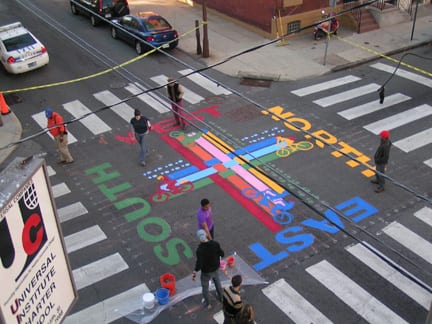
Students and neighbors from SOSNA and UICS painted an intersection mural, “a low-cost way to alert and inform motorists of the school zone,” at 15th and Catharine Streets.
Leading up to the painting project, members of Safe Routes Philly taught bicycle safety to 5th and 6th graders in UICS.
Let us know if you have a creative idea for safe routes in West Windsor. ?Guidelines for mini-grants?are listed on the Safe Routes website.
Because blind pedestrians cannot locate and evaluate traffic using their vision, they must listen to traffic to discern its speed, direction, and other attributes in order to travel safely and independently. Other people, including pedestrians who are not blind, bicyclists, runners, and small children, also benefit from hearing the sound of vehicle engines. New vehicles that employ hybrid or electric engine technology can be silent, rendering them extremely dangerous in situations where vehicles and pedestrians come into proximity with each other.
?The National Federation of the Blind commends the United States Senate for the wise and decisive action taken today to preserve the right to safe and independent travel for the blind,? said Dr. Marc Maurer, President of the National Federation of the Blind. ?The blind, like all pedestrians, must be able to travel to work, to school, to church, and to other places in our communities, and we must be able to hear vehicles in order to do so. This bill, which is the result of collaboration among blind Americans, automobile manufacturers, and legislators, will benefit all pedestrians for generations to come as new vehicle technologies become more prevalent. We now call upon the House of Representatives to pass this legislation as quickly as possible so that it can be sent to the President?s desk for his signature before the close of the year.?
?I?m a major advocate of hybrids?I own one, I drive one, and I?ve seen firsthand their environmental and economic benefits,? said Senator John Kerry, the sponsor of the Pedestrian Safety Enhancement Act. ?This legislation will allow us to continue to promote our energy independence and technological innovation while safeguarding those who use senses other than sight to navigate the roads.?
?The Alliance of Automobile Manufacturers is proud of this legislation, which is the result of our cooperative relationship with advocates for blind pedestrians,? said Dave McCurdy, President and CEO of the Alliance of Automobile Manufacturers. ?We believe that this legislation represents a common-sense approach to ensure that the blind and other pedestrians remain safe as new vehicle technologies emerge.?
In 2009, 27% of fatal crashes in New Jersey involved pedestrians.
Since 1999, New Jersey pedestrian fatalities have remained steady at about 150/year.
Since 2005, pedestrian injuries have ranged between about 5,000 and 6,000 statewide.
In Mercer County, 171 people were injured in 2009.
These are some statistics from a presentation by Gary Poedubicky, Acting Director of the NJ Division of Highway Traffic Safety, to the New Jersey State League of Municipalities in November 2010.
And here are more:
Most pedestrian fatalities occur away from intersections, on roadways without crosswalks.
Approximately 40% of fatalities occur between 3:00 p.m. and 7:00 p.m.
Most pedestrian fatalities occur in urban areas.
More than two-thirds of 2009 pedestrian fatalities were male.
Both pedestrians and motorists must do their part to keep pedestrians safe.?NJ law now mandates that motor vehicles stop and stay stopped for pedestrians in the crosswalk and at intersections.?As well, pedestrians must take ?due care,? and yield the right of way when not in a crosswalk.
West Windsor Township has been awarded a Silver Certificate by Sustainable Jersey.?SUSTAINABLE JERSEY ? is a certification program for municipalities in New Jersey that want to go green, save money, and take steps to sustain their quality of life over the long term. So far, 67 New Jersey municipalities have been certified.
As part of the Sustainability Actions, West Windsor Township Council passed?Resolution 2009-R060 and the Township created a Green Team on which WWBPA President Jerry Foster serves as an advisor. Read the complete Sustainable Jersey West Windsor Profile.
We think it’s also time for West Windsor to apply for Bicycle Friendly Community status from the League of American Bicyclists (LAB). Hoboken and Montclair were recently awarded honorable mentions.
And we’d like to see West Windsor work toward becoming a Walk Friendly Community, a program sponsored by the U.S. Department of Transportation Federal Highway Administration. Just applying can be helpful in making West Windsor more pedestrian-friendly:
“By applying for a Walk Friendly Community designation, your community will receive specific suggestions and resources on how to make needed changes for pedestrian safety. Through the questions in the assessment tool, your communities will be able to identify the areas of needed improvements that can form the framework for your comprehensive pedestrian improvement plan.” (from Walk-Friendly FAQs)
New York City and Washington, D.C. have begun changing the timing of traffic lights to increase pedestrian safety. The Leading Pedestrian Interval (LPI), or Pedestrian Head Start, gives pedestrians a few?seconds to begin crossing the street before drivers have the green light.
This has been demonstrated to work well in large cities, but we believe it could also be useful in West Windsor, particularly at the Route 571/Wallace Road/Cranbury Road intersection (this intersection is currently under construction) and possibly at the Alexander Road/Vaughn Drive intersection (see our previous recommendations for this intersection after a 2008 West Windsor Walk).
Washington State’s Department of Transportation has created five videos to explain how a roundabout works. The third one shows how pedestrians and bicycles should use them.
Separate bike lanes and paths, or share the road? This is a lively debate in the bicycle advocacy community,? almost as controversial as whether bike helmets are good for cycling because they save lives or bad because they discourage too many potential cyclists (also known as the “dork factor”).
Some say paths separated from the roadway are safer and encourage more cyclists. But such paths are costly, have their own conflicts (different speeds among cyclists and between cyclists and pedestrians). Plus, the law says bicyclists have a right to the road (and must follow all the rules of the road). By taking their place in the road, share-the-road proponents say, drivers must acknowledge the presence of cyclists and either pass them safely or go at a slower speed. Poorly designed bike lanes, such as those too close to parked cars and/or traffic, might mean less safety, as one study found. The WWBPA has recommended a two-foot buffer between a lane of parked cars and a bike lane to prevent cyclists riding into a door that is being opened (“dooring”).
One idea in between is “bicycle boulevards,” which optimize low-volume and low-speed streets for bicycle travel and discourage cut-through vehicle traffic (a plus for residents!). In Denmark, Copenhagen is extending its bicycling network outward into the suburbs, creating what the blog Copenhagenize calls “bicycle superhighways,” for commutes of six miles or more. Other interesting ideas are “green wave” traffic lights, which coordinate the signal timing to hit green lights along your route, “branded” signage for specific routes, even bicycle service stations along the way.
Calling all cyclists–and anyone interested in watching a great adventure film as well as helping to benefit a good cause!
Ride the Divide is an award-winning feature film about the world’s toughest mountain bike race, which traverses over 2,700 miles along the Continental Divide in the Rocky Mountains. The film weaves the story of three characters’ experiences with immense mountain beauty and small-town culture as they attempt to pedal from Banff, Canada to a small, dusty crossing on the Mexican border.
The film will be screened on
Friday, December ?3, at 7 p.m. and 9 p.m.
Saturday, December 4, at 7:30 p.m. and 9 p.m.
at the ACME Screening Room in Lambertville.
Extra attraction: Meet-the-Executive-Producer/Cyclist, Mike Dion: at post-film Q & A on Friday at 7 p.m. or at the Saturday Night Cyclist?s Reception at Chimney Hill Inn, Lambertville after the 7:30 p.m. screening.
Mike Dion is one of the cyclists in the film who participated in the race.? The Ride the Divide film project is helping to raise funds for Livestrong, a foundation that fights to improve the lives of people affected by cancer.
Audience members can also do holiday shopping at the event and benefit a good cause. ?Cycling-related merchandise will be sold: 25% of proceeds after cost will benefit the?Young Survival Coalition, young women facing breast cancer together, and 75% will benefit the?ACME Screening Room film program.
For more information:
ACME Screening Room
25 S. Union Street
Lambertville, NJ
Many of the main roads in West Windsor were originally designed for an agricultural economy. Changing them to accommodate suburban design is a challenge.
A sobering statistic is that even though most people live and work in cities, 28% of pedestrian and 30% of bicycle fatalities in 2009 occurred on rural roads.
Many times, Main Street doubles as the most direct connection to the next town, so the risk is that cars are moving faster in an area where people are on foot. Beyond Main Street, those different users, traveling at different speeds, share the road. Changing the road design, such as narrowing? the roadway or adding trees and other sight-improvements, can slow down traffic, making the road safer for all. Widening roads is not only costly but encourages faster speeds.
The WWBPA trustees sent the following Letter to Congressman Jim Oberstar (MN), the chairman of the House Transportation Committee who lost his bid for re-election earlier this month. He has served in Congress for 36 years and was a champion for bicycle and pedestrian improvements, including the Safe Routes to School program.
November 13, 2010
Congressman Jim Oberstar
2365 Rayburn HOB
Washington, D.C. 20515
Dear Congressman Oberstar,
The trustees of the West Windsor Bicycle and Pedestrian Alliance (WWBPA) thank you for your steadfast advocacy of Safe Routes to School and of bicycle-friendly programs and policies. We know that support and funding for many of these initiatives would not have happened without your leadership.
As a local, grassroots organization, the WWBPA incorporates the principles of the Safe Routes program in our effort to make West Windsor Township, New Jersey and the surrounding region safer for pedestrians and bicyclists. We also advocate for ?Complete Streets? (our town has signed on; our county is our next goal) and bicycle lanes as well as fund bicycle racks and promote bicycling and walking through a number of events.
We will miss your vision and vocal support for non-motorized transportation in Congress. It is up to us and the many like us across the country to honor your legacy by working for better and safer roadways, complete with bicycle lanes, sidewalks, and clearly marked crosswalks in all communities.
With sincere thanks,
Trustees,
West Windsor Bicycle and Pedestrian Alliance
The WWBPA conducted another in our series “West Windsor Walks” on Monday, November 8 from 6:45 to 7:15 a.m. at the intersection of Cranbury-Wallace Roads and Route 571. As we watch the construction of a sidewalk and new travel and turn lanes on the bridge over the railroad tracks and await the addition of marked crosswalks, we continue to see conflicts with pedestrian and cars.?Many people cross mid-block both across Route 571 and across Wallace Road as they look for the quickest and, what they perceive to be the safest, routes to the Princeton Junction Train Station.
A letter in The Princeton Packet from Douglas Johnston of the AARP urges passage of ?two Congressional transportation safety bills: HR 1443, The Complete Street Act, and ?HR 3355, The Older Driver and Pedestrian Safety Act.
Johnston notes, “In 2008, the 65-plus population comprised 18% of all car-related pedestrian fatalities, which they made up only 13% of the population.” The bills will fund proven road-design improvements, including the installation of
countdown timers at crosswalks and making traffic signals and markings more visible — improvements that benefit all of us.
Along with our letter of ?thanks to members, we’ve been enclosing bookmarks with the ABC’s Quick Check for bicycles and?A Kid?s Guide to Safe Walking. Member Dick Snedeker reminds us that safe walking skills are for everyone.
The card you enclosed giving safety tips for crossing the street was addressed to kids, but there are many adults who could profit from the same tips. Over the last few years, I have noticed that when driving in Princeton, many pedestrians have become arrogant enough to assume that once they’re in a crosswalk, there’s no need to look out for traffic. Some people don’t even bother to look to see if cars are coming or have a reasonable chance to stop even before they enter the crosswalk. It’s like they’re playing Russian roulette: “If I get hit it’s your fault”–no matter that I’m badly injured, or worse, or that my carelessness was the real cause of the accident.
Case in point: A couple of days ago I was going south on Harrison Street near Southern Way at about the speed limit (25 mph) when I noticed a woman with a stroller in front of her waiting to cross from the other side. She was at a crosswalk, but I was only about 15 yards or so from it (a little more than one second at 25 mph), so I assumed she would wait to start crossing until I had passed. No such luck. Without even looking up for possible oncoming traffic–none was coming in the other direction–she started across, and I had to make a very sudden stop. Even then, she never looked up or seemed to notice my car. Then I saw that the stroller was empty and that she was carrying an infant in a sling around her neck. Her right hand was pushing the stroller and her left hand–you guessed it–was clutching her cellphone tight against her left ear. So much for being a responsible pedestrian. Bah, humbug!!
Since I grew up in the city (Brooklyn) and played in the street a lot, I learned very early that cars are much larger, faster, and harder than you are, and to stay out of their way–even if you’re in a crosswalk.
Dick Snedeker
Dick, thanks very much for the reminder! We’ll create a new bookmark and, in the meantime, please see our Walk Smart Stay Smart page for a list of suggestions and links to more resources about safe walking practices.
Route 571 and Sherbrooke Drive crosswalk today (left) and with simulated addition of Hawk signal (right)
We’ve long advocated for the use of the HAWK (High Intensity Activated Crosswalk), or Pedestrian Hybrid Signal. Since?”a pedestrian hybrid beacon may be considered for installation to facilitate pedestrian crossings at a location that does not meet traffic signal warrants…” (Manual on Uniform Traffic Devices),?we suggest that the Township and the County consider the HAWK for Route 571 at Sherbrooke Drive.
Here’s what the Fall 2010 issue of the US DOT Federal Highway Administration’s Pedestrian Forum says:
The FHWA?s Office of Safety Research recently completed a report on the High Intensity Activated Crosswalk (HAWK)?also known as the Pedestrian Hybrid Signal in the Manual on Uniform Traffic Control Devices (MUTCD). The HAWK is a pedestrian activated beacon located on the roadside and on mast arms over major approaches to an intersection.
The HAWK signal head consists of two red lenses over a single yellow lens. It displays a red indication to drivers when activated, which creates a gap for pedestrians to use to cross a major roadway. The HAWK is not illuminated until it is activated by a pedestrian, triggering the warning flashing yellow lens on the major street. After a set amount of time, the indication changes to a solid yellow light to inform drivers to prepare to stop. The beacon then displays a dual solid red light to drivers on the major street and a walking person symbol to pedestrians. At the conclusion of the walk phase, the beacon displays an alternating flashing red light to drivers, and pedestrians are shown an upraised hand symbol with a countdown display informing them of the time left to cross.
The crash types that were examined included total, severe, and pedestrian crashes. From the evaluation that considered data for 21 HAWK sites and 102 unsignalized intersections, the following changes in crashes were found after the HAWK was installed: a 29 percent reduction in total crashes, a 15 percent reduction in severe crashes, and a 69 percent reduction in pedestrian crashes. For more details, visit this?website.
The HAWK is now an MUTCD approved device, so a request for experimentation is not necessary. Information on its use can by found in Chapter?4f of the MUTCD.
Jay Walljasper reports in?Yes! Magazine on his September fact-finding trip with San Francisco traffic engineers, elected officials, businessmen to the Netherlands to see how American cities might encourage more bicycle use. He concludes that we can do it, but it will take a very serious effort.
We’ve got to start early, with bicycle education and use in the early school years.
We also need to make cyclists feel safe: “physical separation from motorized traffic on busy streets is the single most effective policy for getting more people to bike.”
Walljasper was encouraged to see progress in Rotterdam, where bicycling accounts for 22 percent of trips on the American-looking streets (created after World War II’s destruction).?Simply adding color to bike lanes was, in some cases, helpful. (Cycling is even more popular in other big cities, such as Amsterdam.)
He notes that “it took the Dutch 35 years to construct the ambitious bicycle system we were enjoying. … While the country?s wealth, population, and levels of car ownership have continued to grow through the decades, the share of trips made by cars has not. We could accomplish something similar in the United States by enacting new plans to make urban cycling safer, easier, and more convenient? and ultimately, mainstream.”
Read the whole article and watch the trailer below for Riding Bikes With the Dutch, in which filmmaker Michael W. Bauch chronicles his family?s adventure swapping homes with a family in Amsterdam.
Commuters, take note! Electric bikes (e-bikes, sometimes called hybrid electric bikes) are increasing in popularity. Pedal-assist bikes turn on an electric motor to give the rider an extra boost when the riding gets tough. There are also some called “throttle-assist,” but these are closer to mopeds and might not give riders the thrill of pumping their own bikes or the added health benefit from pedaling. Both types are great for pulling loads, climbing hills, or simply not getting so sweaty when riding to work.
Matthew Zoll, Bicycle and Pedestrian Manager for the Pima County, Arizona Department of Transportation, converted to a hybrid electric bike (he calls it a hybrid, because he uses his own energy as well as electricity) a couple of years ago, using the electric bike from May through October each year, when the temperatures in the Tucson area soar. The rest of the year he uses traditional bikes (pedaled with only his own power), and he says that ?during the past two years he’s only used a car four times. He says he can travel 1,200 miles on just $4 of electricity, with a lot less sweat.
Saving The Planet… And Ourselves Is As Easy As Riding A Bike
Two thirds of America’s energy needs are tied up in transportation. How we get around shapes our communities, our health, and our future.
Americans dream big, but those dreams have gotten out of hand. The results: expanding waistlines, sprawling communities, vehicles so large and thirsty that wars are fought to keep them running, oil disasters, and an energy plan that heats everything up to maintain a way of life. Beyond the blame, America needs real solutions: lean, clean, game-changing answers that put people on the road to health and energy independence.
Joyride: Pedaling Toward A Healthier Planet follows pioneering transportation leader Birk’s 20-year crusade to integrate bicycling into daily life. With just a table scrap of funding, Birk led a revolution that grew Portland, Oregon into a city where bicycling is a significant part of their transportation system. Birk then hit the road, helping make communities across the nation healthier, safer and more livable. While many books bemoan the pain of the world’s problems, Joyride offers hope and a blueprint for changing our world for the better.
Mia Birk is the award-winning CEO and co-owner of Alta Planning + Design, a 72-person international firm dedicated to creating active communities where bicycling and walking are safe, healthy, fun, and normal daily activities. She has been involved across North America in hundreds of bicycle, pedestrian, trail, and Safe Routes to School plans, projects, and programs. Birk is also Adjunct Professor at Portland State University, where she co-founded the Initiative for Bicycle and Pedestrian Innovation. She is a co-founder of the Cities for Cycling project of the National Association for City Transportation Officials and the Association for Pedestrian and Bicycle Professionals. She was the Portland Bicycle Program Manager from 1993-1999, Transportation Program Manager at the International Institute for Energy Conservation from 1990-1993, and has a Master?s Degree in International Relations from Johns Hopkins University School of Advanced International Studies.
Birk lives in Portland, OR, with her two children, ages 11 and 8. Bicycling is her main means of transportation, and a winning strategy for maintaining her family?s health, safety, budget, and community connection.
Book sales will support non-profit organizations working to creating a healthier, more sustainable world.
Joyride: Pedaling Toward A Healthier Planet
By Mia Birk
With Joe “Metal Cowboy” Kurmaskie
Cadence Press www.miabirk.com
Comments Off on Joyride: Pedaling Toward A Healthier Planet
Monthly meetings are held on the second Thursday of the month, at 6:15 pm at the WW library and via Zoom. Email us at [email protected] for details, including the Zoom code.
Find us at the West Windsor Farmers Market (Vaughn Drive parking lot) from 9 a.m. to 1 p.m. every other Saturday from May through Halloween.
 Freehold residents and shop owners this month discussed a plan? to make the borough’s downtown friendlier for bicyclists and pedestrians. Issues included adding a traffic signal, where to place bicycle racks, building more sidewalks, and police enforcement.
 John Boyle of the


 Calling all cyclists–and anyone interested in watching a great adventure film as well as helping to benefit a good cause!
 Many of the main roads in West Windsor were originally designed for an agricultural economy. Changing them to accommodate suburban design is a challenge.


 Jay Walljasper reports in?

